Brand Governance Is a Template Problem (And How to Fix It)
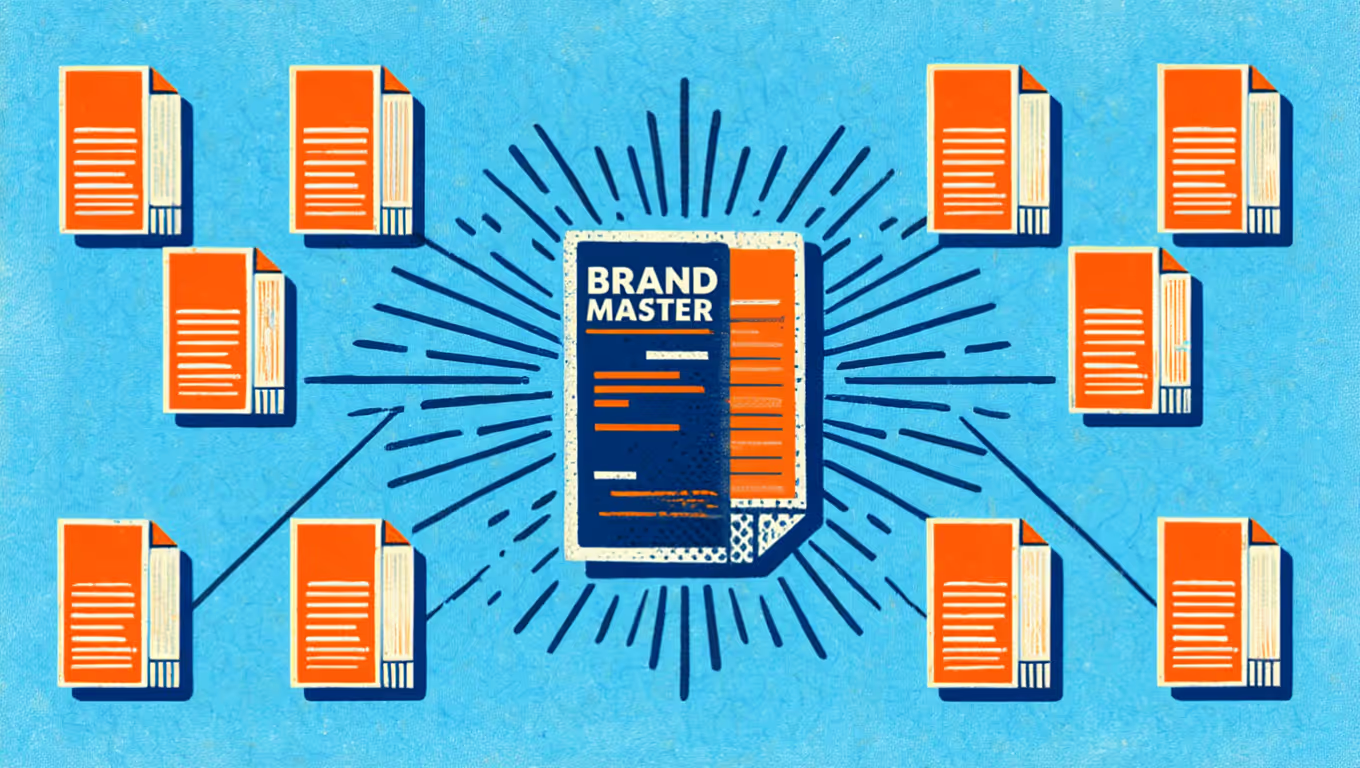
Every organisation I've ever worked with has a brand guidelines document. Usually it's a PDF. Usually it's beautiful. And usually, nobody reads it.
I don't say that to be unkind. Brand teams put enormous effort into creating comprehensive guidelines: colour values, typography specifications, logo usage rules, spacing requirements, tone of voice. The documents themselves are often works of art. The problem is that the people who actually create the organisation's day-to-day materials (the marketing coordinator drafting a proposal, the sales rep building a pitch deck, the operations manager putting together a monthly report) almost never open them.
They're in a hurry. They have a deadline. They know roughly what the brand looks like. They do their best. And their best, while well-intentioned, slowly drifts further and further from the brand standard. One slightly wrong shade of blue here. A non-brand font there. A logo that's been stretched, squashed, or placed on a background that makes it unreadable.
This is brand drift. And it doesn't happen because people are careless. It happens because the system makes it too easy to go off-brand and too hard to stay on-brand.
The policing approach doesn't scale
The traditional response to brand drift is some form of policing. Brand reviews. Approval workflows. That email from the marketing team saying "please use the correct shade of teal." Some organisations even hire brand compliance officers whose entire job is catching and correcting off-brand materials.
It sort of works. For a while. In small organisations. But it doesn't scale.
When you've got 500 people across 12 departments creating documents, presentations, proposals, and reports every day, no brand team on earth can review everything. Materials slip through. The brand police can't be everywhere. And the more they try, the more they become a bottleneck that frustrates the people trying to get work done.
Research into brand management in 2026 consistently points to the same conclusion: enforcement-based approaches to brand consistency are less effective than infrastructure-based approaches. In plain English, you get better results by making it easy to stay on-brand than by making it painful to go off-brand.
The real cause of brand drift
If you trace most brand inconsistencies back to their source, you'll find a common pattern. Someone needed to create a document. They couldn't find the right template, or the template they found was outdated, or it didn't have the layout they needed. So they improvised.
That improvisation is where brand drift lives.
The root cause is access friction. If the right template is harder to find than a workaround, people will choose the workaround every time. If the template exists but doesn't cover the use case they need, they'll adapt it in ways the template wasn't designed for. If the template is there but the formatting isn't properly controlled, they'll "just tweak a few things" and those tweaks will compound.
This is why brand governance is fundamentally a template problem. The brand guidelines can be perfect. The brand team can be brilliant. But if the templates people actually use every day don't enforce those guidelines automatically, the guidelines might as well not exist.
What template-driven brand governance looks like
A template-driven approach to brand governance starts with a different premise. Instead of telling people what they should do and hoping they comply, you build the compliance into the tools they use.
Here's what that looks like in practice.
Your PowerPoint templates include master slides with properly structured layouts, brand-approved colour palettes, and the correct fonts. Users can't accidentally change the brand colours because the palette is built into the theme. They can't use the wrong font because the style hierarchy enforces the right ones. They can choose from a range of professionally designed layouts, but they can't break the underlying brand structure.
Your Word templates use a proper style hierarchy that maps your brand typography to Word's heading and paragraph styles. Heading 1 is always your brand heading font, at the right size, with the right spacing. Body text is always the right font, the right size, the right line height. Users don't have to remember any of this. They just select the style they need and the formatting is correct.
For more complex documents (proposals, reports, annual reviews), content controls guide users through the document structure, showing them exactly where to enter content and how it will be formatted. There's no guesswork, no "I'll just use a text box," no freestyle formatting that drifts off-brand.
And for organisations that produce high volumes of documents, VBA automation can handle repetitive tasks: generating tables of contents, applying consistent numbering, formatting tables, and inserting boilerplate content. The automation ensures consistency that manual formatting can never match at scale.
The result is an environment where going on-brand is the easiest option. It's the default. It's what happens when someone opens a document and starts typing. Brand compliance stops being a thing people have to actively remember and becomes a thing that just happens, automatically, every time.
The single source of truth
Template-driven governance works best when there's a single, centralised source for all templates. If people have to hunt through shared drives, old emails, or "the folder that Sarah set up that one time" to find the right template, you've already lost.
A properly managed template system is easy to find and easy to use. It's the first thing people see when they open Word or PowerPoint (ideally through a custom tab or ribbon that's been integrated into their Office environment). The templates are always the current version, always accessible, and always correct.
This centralisation also solves the versioning problem. How many organisations have three different versions of their PowerPoint template floating around, one from the current brand, one from the rebrand before last, and one that someone customised for "their team"? A single source of truth means everyone is working from the same, current, approved templates. Always.
When you combine centralised template access with proper technical controls (master slides that guide users toward on-brand choices, styles that resist manual formatting, content controls that structure the document), you create an environment where brand consistency is the natural outcome, not something that requires constant vigilance and intervention.
The business case is straightforward
Brand governance through templates isn't just about looking consistent (though that matters enormously in competitive markets). There's a practical business case too.
Time savings are immediate and measurable. When people don't have to search for templates, fight with formatting, or redo work because it went off-brand, they spend more time on actual content. We've seen organisations recover hours per person per week by replacing their ad hoc document creation process with a proper template system. Across a large organisation, that recovered time adds up quickly.
The risk reduction is real too. In regulated industries, document consistency can have compliance implications. In client-facing roles, a proposal that looks professional and on-brand creates a fundamentally different impression than one that looks like it was cobbled together from three different PowerPoint files. Your documents are often the first tangible impression a client or partner has of your organisation. If those documents look inconsistent, what does that say about the organisation behind them?
And then there's the scalability argument. An organisation of 50 people might be able to manage brand consistency through individual effort and the occasional reminder. An organisation of 500 or 5,000 cannot. Templates are the only approach that scales without requiring the brand team to grow proportionally.
The expertise gap
Here's the part that trips most organisations up. Building a proper template system requires a specific combination of skills: design expertise (so the templates look beautiful and on-brand), technical Office mastery (so they're properly built with correct master slides, style hierarchies, content controls, and automation), and systems thinking (so they anticipate how real users will actually use them, and the forty-seven creative ways those users will try to break them).
Most design agencies can do the design part. Very few can do the technical build. And even fewer think about the systems architecture.
That gap is why so many organisations end up with "templates" that are really just branded starting points: a logo on a blank slide, some suggested colours in a Word document, maybe a few standard layouts. They look right on day one. By day thirty, they've been customised, modified, and reformatted beyond recognition. Back to brand drift.
Proper template architecture is specialist work. It requires understanding both how design should look and how Office actually works under the hood. It's not glamorous, but it's the difference between brand guidelines that live in a PDF nobody reads and brand standards that are embedded into every document your organisation produces.
If your brand guidelines are gathering dust (even digital dust), it might be time to look at the problem from a different angle. Our free Template Health Check is a quick way to see where your current template system stands, and where the gaps are.
Need a branded template? We can turn it around overnight.
Australia's Microsoft Office template specialists with a South Africa team that delivers while you sleep.



RAVE REVIEWS
who we work with


.svg)
.svg)
.svg)
.svg)