Copilot Now Reads Your Slide Notes. What Should They Say?

On 11 September, Microsoft pushed a change to Copilot in PowerPoint that almost nobody noticed. It arrived as a message centre post (MC1470415, if you like a reference number) and it's a much bigger change than its size suggests. Copilot will now read the speaker notes in your template and follow them as instructions.
There's a second setting alongside it called strict brand adherence, which restricts Copilot to the layouts already in your slide master and stops it inventing new ones. Neither setting is switched on by default. Somebody at your end has to go and turn them on, and only a Brand Kit owner or a designated brand manager can do it.
So the obvious question, if you've got a Copilot-ready PowerPoint template sitting in a Brand Kit: what should those notes actually say?
What is notes steering in Copilot for PowerPoint?
Notes steering is a setting that lets Copilot read plain-language instructions written into the speaker notes of a template and apply them every time somebody generates a presentation from that template. It's enabled per template, using an "Allow note instructions" checkbox when the template is uploaded to a Brand Kit.
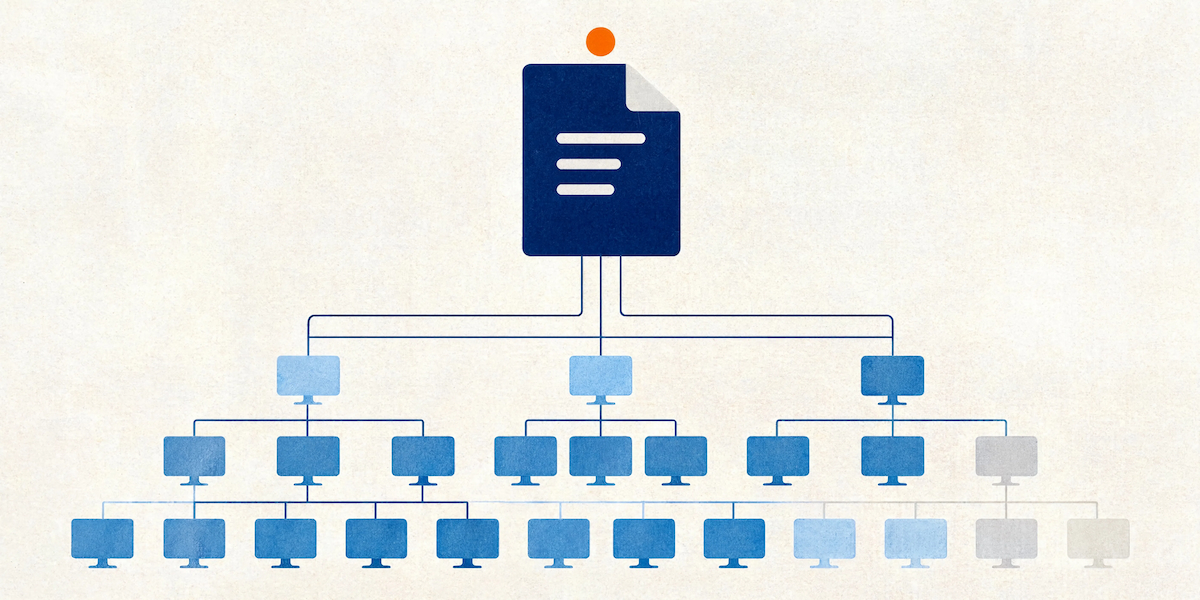
The instructions live in the template file itself, so they apply to everyone using it, whether that person knows the brand rules or has ever opened the guidelines PDF. Nobody has to type them into a prompt. Microsoft's own examples include requiring certain slides to appear, preserving branded content, holding a slide order, and controlling how much text goes on a slide.
Strict brand adherence works differently. It's set across the business rather than per template, and when it's on, Copilot uses only the template and slide master layouts and can't add or remove placeholder content. Leave it off and Copilot has more room to improvise while still pulling your colours, fonts and logos.
Two settings, two different jobs. One tells Copilot what to say. The other tells it what it's allowed to build.
Why this matters more than it sounds
For about two years, the standard advice for getting decent output from Copilot in PowerPoint has been "write a better prompt". That advice puts the burden on the person in the biggest hurry, which is why it mostly doesn't work. The sales manager assembling a client deck at 6pm has no interest in prompt craft. They want slides.
Notes steering moves the instruction into the template, where it belongs. The brand rules travel with the file, so remembering them stops being anybody's job. That's the same principle behind every well-built template we've ever handed over: put the rules into the structure so nobody has to read a document to comply with them.
But of course there's a catch. Both settings assume you've got a template worth adhering to.
Strict mode will show you exactly how thin your master is
Switch on strict brand adherence and Copilot can only use what's in your slide master. If your master has a title slide, a title-and-content slide and a blank, then a deck generated under strict mode will be title, content, content, content, content, blank.
Copilot has done exactly what you asked of it. Your template has five layouts and a logo.
A template that rewards strict mode has layout coverage: section dividers, two-column comparisons, a quote layout, a full-bleed image layout with a text panel, a stat or number callout, a team layout, a timeline, a process layout, a table layout with the header row already styled, a chart layout with the placeholder sized to the grid. Thirty or forty layouts in a corporate deck is a sensible number. It decides whether Copilot has options or one option on repeat.
Layout names matter too, and that setting gets skipped more often than any other. Copilot chooses layouts partly by what they're called. "1_Title and Content" tells it nothing. "Section Divider - Dark" and "Comparison - Two Column" and "Stat Callout - Three Figures" tell it a great deal. Renaming forty layouts in the slide master takes an afternoon and improves output immediately, with or without strict mode switched on.
What to write in the notes
Start with the things people always get wrong, because those are the rules with a measurable return. A few patterns that work:
- On the title slide: "Always keep this slide first. Do not change the logo placement or add a subtitle below the client name."
- On a mandatory slide: "This safety and compliance slide must appear in every deck, immediately after the agenda. Do not edit the wording."
- On a content layout: "Maximum six bullet points on this layout, maximum twelve words per bullet. If the content needs more, split across two slides using this same layout."
- On a section divider: "Use this layout between major sections. Heading only, no body copy."
- On a data layout: "Use the chart placeholder on this slide. Do not paste screenshots of spreadsheets."
- On a closing slide: "Always end with this slide. Keep the contact details exactly as written."
Write them the way you'd brief a new starter. Plain sentences, one instruction each, no hedging. "Try to keep bullets short" gives Copilot nothing to work with. "Maximum six bullets, maximum twelve words each" gives it a rule.
Be careful about instruction volume. Notes that run to a paragraph per slide across sixty layouts start competing with each other, and the useful rules get diluted by the obvious ones. Pick the handful of things that actually break your decks and write those.
The ones people forget
Tone and audience instructions work well in notes, and almost nobody writes them. "Write in Australian English. Avoid American spellings." saves an editing pass on every deck. "This template is for external client presentations. Avoid internal acronyms and expand any that are unavoidable on first use." saves an embarrassing one.
Terminology rules work too. If your business insists on "members" rather than "customers", or has a product name with a specific capitalisation, that instruction in the notes is worth more than the same instruction in a brand guideline nobody opens.
And a small one that pays for itself: an instruction telling Copilot not to change the slide order it's been given. Reordering is the single most common complaint we hear about generated decks, because a presenter builds a narrative and then finds the argument arriving before the evidence.
Where the notes go, and where they don't
These instructions live in the notes of the template slides, which means they travel with the file. A few practical points that will save you a support ticket.
Instructions written into notes on individual slides of a finished deck do nothing. The setting applies to templates in a Brand Kit, uploaded by a brand manager with the checkbox ticked. If your template is sitting in a SharePoint folder that people copy from, this feature isn't reaching it.
Presenters can see the notes. If you've written "do not let anyone move this slide, the compliance team will have kittens", somebody will read it out loud during a rehearsal. Write instructions you'd be comfortable having on a screen in front of a client.
And the notes pane still does its original job. If a layout carries real speaker guidance alongside the Copilot instruction, separate them clearly so the person presenting can tell which is which.
What these settings won't do
Strict brand adherence keeps Copilot inside your layouts. It doesn't make the deck good. You'll get a correctly branded, correctly structured, competently formatted presentation, and for a fortnightly update or an internal project review that's exactly what you want.
For the board deck, the investor presentation, the pitch that decides a two-year contract, you still want a designer. The custom infographic that explains your delivery model in one picture, the chart that's been redrawn so the story is visible in two seconds, the build sequence that reveals an argument one piece at a time: Copilot doesn't do those, and strict mode doesn't change that. What it does is stop everything else from looking improvised.
The split is worth being honest about. Copilot paired with a well-built template handles the volume. Designers handle the decks that have to win something. Businesses that understand which is which get value out of both.
Where to start this week
If you've got a template in a Brand Kit, open it and count the layouts. If the number is under fifteen, switching on strict brand adherence will make your output worse, because you'll be locking Copilot into a template that can't express your content. Fix the master first.
If the master is solid, check the layout names, then write instructions into the notes of the ten layouts that matter most. Generate three test decks on three different briefs, read what comes back, and adjust the wording. It's an iterative job, closer to tuning than configuring, and an hour of it will change what your whole business produces.
And if you're looking at a template built in 2019 that's been through two rebrands and a merger, this is the moment to rebuild rather than patch. Copilot exposes template weaknesses faster than any human user ever did, because it uses every layout, reads every placeholder and follows every instruction with no judgement about which parts were meant to be there.
Jim is a co-founder of Ideaseed and its technical lead, with deep expertise in Microsoft Office templates, automation, VBA, VSTO and Office.js development. He builds the template architecture behind Ideaseed's enterprise work, making sure it holds up at scale across both Mac and PC.
Not sure whether your PowerPoint template is ready for any of this? Our free template health check takes a few minutes and tells you where the gaps are.
Need a branded template? We can turn it around overnight.
Australia's Microsoft Office template specialists with a South Africa team that delivers while you sleep.


RAVE REVIEWS
who we work with


.svg)
.svg)
.svg)
.svg)